Showing posts with label Short Story. Show all posts

Thursday, May 31, 2018

The Country Doctor, Franz Kafka

   Franz Kafka's novella, "Metamorphosis,"  and short story "The Hunger Artist," has forever placed Kafka as one of my personal top 10 or 20 preferred writer's list for the 20th century. So, when I found "The Country Doctor" by Kafka on feedbooks.com, I of course had to read it. It would seem that it is supposed to be a series of stories. I must hunt down the rest of them and be a bit more diligent in hunting down as much of his work as I possibly can.
   I'm not sure how to look at this story. It's like a backtrack to a very distant age when doctors were largely incapable of doing very much to help people. Their equipment was extremely primitive. For instance, when he listens to the heart of the patient, he must place his head against the chest rather than use any instrument.
   He discovers that the problem with the farmer is that he is infested with worms. There's nothing he can do to help him. Regardless, he is stripped naked and forced to lay with the dying man by the family. He is instructed to save the man or be killed should the man die. Fortunately, he is able to escape through the window with his clothes in hand with the assistance of a powerful team of horses which he had been able to borrow.
   I had no idea what kind of story this was when I started it. But it was definitely a journey into a very strange world. What a loss to literature it was when he died so young. What amazing literature he left behind. He really has very very few peers.

Dark Shanghai, Robert E. Howard


   There are a lot of Robert E. Howard stories on my blog this month. This story follows a sailor, Steve Costigan, who is unusually eager to get himself into trouble. Unlike many of Howard's heroes, this one is particularly stupid. He is so stupid, it becomes half comic, half adventure story.
   He is tricked into thinking that there's a girl who has been kidnapped. So, he goes to rescue her. She fights them tooth and nail. But, at no point does he consider the idea that he's been duped. He believes that he is taking the young woman to her brother.
   As he drags her kicking and screaming to the man he believes is her brother, the truth unravels. The man is not her brother. They are in fact competing thieves for a formula believed to be the equivalent of Ambergris. Ambergis is whale vomit which is used for high end perfumes and is incredibly valuable. 
   So, now that he's aware of having committed a wrong, he does everything he can to fix his mistake. He takes on them all and unkidnaps her. The formula, however, was ripped out of the book she'd hid it in by chance by his partner as a stopper for his bottle of liquor (as the normal stopper was lost). However, upon finishing the bottle, the partner happened across a man who bought it from him for enough money to buy another bottle of booze.
   So, while the characteristics of Howard's main character are somewhat changed into a comical idiot, the fearlessness and adherence to a barbaric code of honour remains hard coded into the character's core. 
   There is definitely some anti-Asian racism in this story. The Chinese characters are referred to as yellow devils. Certainly, the main character thinks nothing about the non-white characters. This is beginning to be a problem for me in how I appreciate Howard as a writer.

The White Stocking, D. H. Lawrence

  
   D. H. Lawrence is one of a few legendary English literature writers of the last century that I have not read anything of. I'm not sure why. I guess I have always had this idea that his writing would be dreadfully boring. This is rather silly I suppose. For what reason I have this impression from him I could not say. Did I see a movie or film adapted from one of his stories or novels and find that boring and used it to forever tarnish my impression of him? I cannot really say. Well, I often see his name on lists of controversial books. Controversial books and writers are often more interesting than the rest. So, I guess I finally found myself motivated to read this short story of his. "The White Stocking" is available in various formats at goodreads.com.
   I think that if I had read this story 10 years ago I might have found it to be boring as expected. But I found some perverse pleasure in reading it. It's the story of a yearling wife who hasn't quite moved on past the other relationships with other men that tempted her before her choice of husband. The other man had decided to send her earrings and the stocking she had lost at a party which had ultimately defined her choice of husband.
   She hadn't quite moved on from that scene and hung onto the fond memories of her with this other man. As her husband discovers that she still has some interest in her former admirer, and she becomes internally cognizant of her lustful desires, and aware of the lustful desires he had had for her, he becomes enraged. On the verge of uncontrollable anger, he strikes her.
   At least for the moment, she is subdued. They fall asleep together in each others arms.
   This story seems to be about how to own your wife when she's thinking of other men. I can't help but wonder that feminists haven't torn this short story to shreds. Where is Lawrence on this? There's the idea that a writer can write a story about something while holding it at arm's length. This is the story free from any judgment. But I think it was an endorsement.
  

Monday, May 28, 2018

Son of the White Wolf, Robert E. Howard

   This is one of several by Robert E. Howard that I've read over the past little while. This one can be found for free at Australia's version of feedbooks.com. There are many other Howard tales available there. This is another El Borak tale in
   The story follows a shift in power in Turkey as Germany's military begins to fail at the end of WWI and the Brits are taking over. A small time leader decides to begin a mad dash for power. He kills the German authority, kills the old men, women, and young children, and kidnaps the women with the intention of starting a new race in an old Pagan religion.
   Howard was a Texan. To be honest, I have a prejudice against Texans. I see them as a lot of racists and Bible thumpers. Howard, of course, being a favorite of my youth, is Texan. So, he is a bit at odds with my prejudices.
   Speaking of prejudices, my radar is perhaps a bit sensitive. Howard writes that villagers 'crept from their hovels to stare in awe at the first white woman most of them had ever seen.' There is this impression that Howard, much like Edgar Rice Burroughs, felt that the white barbarian was the greatest barbarian. The white barbarian has the brains of a white man, and the ferocity of the 'other races.' He is deadly, but still a gentleman with the ladies, unlike the other races.
   So I worry about this sort of thing that would tarnish my impression of this particular Texan. I have sometimes thought that he wasn't really the racist that so many others are. But love is blind, right? Maybe the fact that I liked him particularly well blinds me to the fact that he might have been a raging promoter of the Aryan super race.
   But, while he has often spoken poorly of the Kurds (in this story and another), he did write of the Arabs who fought beside the hero, El Borak. "A stern chivalry was the foundation of their (Arab) society, just as it was among the frontiersmen of early America. There was no sentimentalism about it. It was real and vital as life itself." So, this passage seems to vindicate him at least in respect to the Arab/Muslims.
   Most of Howard's women are rather weak creatures. But as the tale comes to its conclusion, the woman whom he is supposed to know as a German enemy, he actually knows as a British undercover double agent. Borak gives his respect to her. Howard did have some tough women: Red Sonja, Belit (the pirate captain), and Valeria. They weren't just strong women, they were dominant alpha humans who were not the weak things that the men around them were supposed to rescue.
   In fact, that's sort of one of the reasons why I have always been particularly fond of Howard. His women were not the weaklings that so many other authors portray/portrayed them as. In terms of the charge of racism, this jurist needs to weigh more evidence before a conclusion can be reached.

Tuesday, September 13, 2016

Security, Poul William Anderson

This is the last story of Poul William Anderson's that I downloaded from feedbooks.com. There are a few more that I didn't download yet. So there are two more to come. Poul William Anderson (1926-2001) is a brilliant science fiction writer, worthy of the acclaims and accolades that have been given to him. "Security" is another short story, well worth downloading and reading. It is available at feedbooks.com.

This short fiction has political elements that are similar to "Industrial Revolution," whose review can be found in the link provided.

America has become a tyrannical power which no longer holds to democratic elections. Those who disagree with the state are often taken into custody and never seen again. Subversive talk is treason, and being accused of treason is the same as being given a death sentence.

Dr. Lancaster is a brilliant physicist who doesn't realize the predicament that his culture is in, or the loss of individual freedoms. He is one of the masses who believes that what the government does is right and necessary.

There are rebels, and they need a good physicist who can help them develop weapons that can be made cheaply while being better than their contemporaries. They manage to trick Dr. Lancaster into believing that he is being brought out into space to develop some technology which will give the rebels this edge: a kind of way to store a great deal of energy. A super battery, in effect, which can be used for powering weapons and vehicles in a revolutionary way.

By the time he has succeeded in his project, he has begun to appreciate the community of the research lab. He isn't under constant threat of security. He doesn't have to worry about saying the wrong thing. He feels free (though I don't think that's how rebellions really work. Usually they're just a different form of tyranny). This is something that catches in him. When he returns to earth, he cannot help but start to see through government hypocrisy, the fake manufactured news, and the seed of doubt begins to grow. However, he is still content to continue on.

While he was gone to that space station where the research was taking place (why not on earth in a bunker... maybe the process required something that the vacuum of space has that a bunker doesn't. I'm not entirely certain.), a double was placed for him so that no one would know he had been abducted. This would have worked, but the project manager, Berg, had ratted on him. The government picks him up, tortures him, trying to get him to give up the secrets. At the end of the torture, he's come to realize that he's covering for the rebels, and he's still ready to die with the secrets. Berg, however, arranges to have him rescued. It was a kind of test, and he wanted him back to continue doing his work.

The story was quite enjoyable. Poul William Anderson is a really good writer who has something interesting to say, something to think about in his stories.

Eventually, someone rats on him

Monday, September 12, 2016

The Man Who Came Early, Poul William Anderson

"The Man Who Came Early" (1956) is a short story by Poul William Anderson.

"The Man Who Came Early" is one of those stories within a story. The narrator tells the story to a priest about a strange young man who came to Iceland before 1,000 AD. Somehow, he was struck by lightning which sent him from the then modern world to the very old world where Vikings were one of the great European powers.

This story is extremely well told. I really enjoyed it and highly recommend taking the time to read it. I read it from start to finish without putting it down. The style has a real charm and rhythm to it which shows how skilled Anderson can be.

Many people might suppose that by having many skills and knowledge from a modern time that they might flourish in an age a thousand years gone. However, this story does a good job at repudiating such a belief.

The young man, "Sergeant Gerald Roberts of the United States Army base on Iceland" is an engineer working for the US army. Therefore, he feels he can be an important contributor to his host (who is also the narrator of the story). However, the tools are very primitive: a hammer, a forge, and little else. He is unable to do much with these tools. He then tries to reinvent the sailboat, but it does not fit the requirements.

As time goes on, he and his host increasingly feel his worthlessness to the house and community. But it does not stop Helgi, the narrator's daughter, from falling in love with him. Another was in love with her, which sets up the fight. With an axe, and little such battle experience, he cannot win the battle. He resorts to using his firearm, which causes more problems. The family of the slain wants revenge, and he loses his host's graciousness as a result.

The family of the slain man go after him until he runs out of bullets. He then puts on a fight with the sword that they respect, but he ultimately cannot withstand their attacks and dies.

I think the premise of a modern man in an old world is a good one. Though, it is not the first effort to do so, it is well done. I definitely recommend reading it.


Saturday, September 10, 2016

The Burning Bridge, Poul William Anderson

"The Burning Bridge" (1960) is the second of five available Poul William Anderson (1926-2001) ebooks available at feedbooks.com. It is a good short story and I recommend reading it.

This is the story of a long voyage from Earth to a planet called Rustum. The passengers are mostly frozen in a deep sleep due to the longevity of the voyage. The deep sleep allows for fewer fights over cabin fever. The crew take shifts so that some are able to take care of the ship and her needs while others sleep. They are political dissidents who are given the chance to live on another planet.

Earth is inferred as a dirty used up planet ravaged by war and humanity (fairly accurate description for this century as well). Rustum has been visited previously, and is described as being a kind of clean slate. The air is fresh. There are new opportunities there for the colony.

A message from earth, however, creates a conundrum for the protagonist, who is also the captain on duty. The message is that the ships are free to return to earth. The 'education decree' is the legislation that they are trying to escape. It sounds much like some kind of forced propaganda: perhaps similar to something big brother would do in George Orwell's brilliant novel, 1984, when finding people that thought outside of what was required.

Women and men are segregated during the voyage. Even married couples are not allowed to be wakened at the same time. When they have a video conference, the women must wear a veil (sounds Muslim to me) so as to not make the men horny. The men do not have a similar requirement. It is an ongoing cultural phenomena that is funny (as in sour milk, not ha-ha) to see in science fiction. Today, there are female students who have a different dress code than the boys. They cannot show a part of a bra or too much thigh in case it distracts the boys and causes problems. I suppose in the future this problem will not be solved, either. The hypocrisy remains in tact.

Another rather sexist point that is made in the story comes from the female he consults with over the conundrum of either continuing onto Rustum or returning to earth. Teresa says of how women think, and their place in making such a critical decision about their future:

"Few of them (the women) really wanted to come (to Rustum) in the first place. They did so only because their men insisted. Women are much too practical to care about a philosophy, or a frontier, or anything except their families."

The ship is close to a no return point where it would take as long to stop and turn around to return to earth as it would to continue on to Rustum. In fact, there would be little difference in time to simply go to Rustum, decide collectively who would stay or go. However, it is reasoned that they are decades away from being able to reach earth, and that changes may take place in that interim which would make everyone want to go back to Rustum. However, there is not enough fuel to change their minds again, and there might not be another chance at the voyage should governments on earth decide not to resend the ships.

Therefore, after much deliberation, Coffin decides that they are better off to go to Rustum regardless of the political situation on earth. However, he fears a mutiny should he try to force the issue. He decides to make a fake message designed to make everyone decide to continue onto Rustum. He makes a message sound like they are being compelled to return to earth, which of course would have the opposite effect. In his effort to create this tape, an officer catches him. They fight, and he forces the man into 'the vat' where he can sleep until the end of the voyage.

It's an interesting story and worth reading. Reading these science fiction stories certainly gives me an interesting view into how women were (and arguably still are) treated and perceived. I wonder if any stories out of the Golden Age of science fiction viewed women as equals or perceived a future where women would be treated as such.

Monday, September 5, 2016

The Feud Buster, Robert E. Howard

I think, for as long as I can remember, I've been a big fan of Robert E. Howard's. Robert E. Howard (1906-1936) was a pulp fiction writer who died far too young. When his mother died, he decided to take his own life. Conan the Cimmerian is his most famous character, and probably his best. I grew up reading Marvel's renditions of Howard's barbarian tales, read his books, and watched the movies Feedbooks.com.
countless times. Later on I read some of his other books, which are also good entertainment. "The Feud Buster" is available freely at

The narration is in first person from the point of view of a massive and powerful man, Breckinridge Elkins. He's mistaken at one point for a bear. He believes his sister has given up herself to a man named Dick Jackson. This makes him very angry and so he sets out to force Dick Jackson to marry his sister. The language of the narration is quite entertaining. It's a kind of hillbilly dialect which is easy enough to read and adds a certain charm to it.

Like his other hero, Conan, this guy is of near super hero ability. When he's trying to figure a way into the cabin in which Dick Jackson is in, he hears a mountain lion in the hills. So, he goes up into the hills, finds the lair of a male lion, grabs the lion by the hand and throws him through the window of the cabin. When the lion does its thing, enemies of the family are about to string up Dick Jackson, but because he wants Dick Jackson for his sister, he's ready to fight all seven of them to get him. If it had been mere knuckles and whisky bottles, I'm sure it wouldn't have posed much of a problem for the brawny bearish giant. But, they had their rifles ready to defend their hanging. But it wasn't for himself he was wary.

But for one thing I'd of taken them guns away and wiped up the floor with them ungrateful mavericks. But I was afeared Jackson would get hit in the wild shooting that was certain to foller such a plan of action.

But the cabin, already damaged from the rampaging lion, had only the main post at the center of the hut. So, he tears it up and the roof comes crashing down on them all. He pulls Dick Jackson out of the rubble and takes him back to his sister.

But, Dick had failed in his attempt to woo his sister, and had decided to slut shame her for it anyways. Breckinridge lets him go (I don't know why. He deserved an ass kicking).

Howard has a way with telling a story. I don't know if there's anyone like him. He has the ability to grab my attention from the first paragraph and hold it steady until the last paragraph. This story is the hell of a fun one. If you like a good comical super human gun slinging Texan story, I highly recommend this one to you.

Warm, Robert Sheckley

"Warm" (1953) is a very short story by Robert Sheckley (1928-2005) available for free on Feedbooks.com.

I'm not entirely sure what to make of it. It seems like the result of an acid trip. The narrator never mentions taking any kind of drugs. However, there is someone inside the narrator's head asking for help. This is the second time I've seen the theme of two people in one mind I've read today from Sheckley.

As the story progresses, the world becomes more and more surreal. His girlfriend, the people at the party, a beggar, all become little more than robots, flesh, and atoms, in a kind of deconstructive vision. At the end of the story, the narrator finds himself on his bed, dressed.

It definitely seems like some kind of LSD trip.

Reborn Again, Robert Sheckley

Robert Sheckley (1928-2005) is a well respected author of science fiction. I have read most of his free short fiction. "Reborn Again" is available freely at Feedbooks.com.

This is a story about two people or souls in a single mind and body. Ritchie has money. He needs a new body. Grelich is a bit of a philosopher who wants to end his life. Grelich's choice is something of a suicide.

However, the operation does not go according to plan. The surgeon cannot bring himself to end the life of Grelich. So, when Ritchie wakes up, he finds that the two of them are in the same mind and body together.

Initially, Ritchie doesn't want Grelich in his life. He doesn't have any negative feelings for him. He's just not happy sharing the body. Further, Grelich has a kind of control over the mind and body while Ritchie 'sits in the back seat.'

There is no attempt at fraud. It was never Grelich's intention to keep the body and inherit Ritchie's wealth. Nor is Ritchie a bad person who is happy about the thought of murdering Grelich, even if Grelich is willing to follow through with his original intention.

Ritchie is a lonely person, having some family still alive but not at all a part of his life. His parents are gone. He is introduced to Grelich's friends, whom he has a near instant fondness for. He ends up deciding that it is better to be a 'mindmate' than to be lonely. They decide to try to cohabitate together.

Sheckley is an interesting writer, without doubt. The beginning of this ebook has an introduction saying that Sheckley deserved better recognition. Perhaps this is true. Sheckley is gone, however, and I'm sure his position within the rankings of "Science Fiction and Fantasy Writers of America" is irrelevant. 

The Big Trip Up Yonder, Kurt Vonnegut

This is the second short story of Kurt Vonnegut's (1922-2007) that I have read. "The Big Trip Up Yonder" (1954) is available freely at Gutenberg.org. There are not many of his stories on Gutenberg.org, so unless I can find more of them elsewhere, this will be the last.

"The Big Trip Up Yonder" is similar in theme to his other story, "2 B R 0 2 B". Aging has been cured. Unlike "2 B R 0 2 B", no attempt at population control has been made. Growing food hasn't kept up with the population. Breakfast is "egg-type processed seaweed." The apartment is very small, but occupied by many generations. The eldest owns it, and has control over where those who live in the apartment may sleep.

The medicine that is used to stop aging is 'anti-gerasone.' To get rid of Gramps Ford, the medicine is poured down the drain. Gramps Ford catches Lou in the act, but says nothing. The next day, they discover a note with a will leaving the small apartment to them all in equal proportion. This creates a battle which " 500,000,000 delighted viewers on the Eastern Seaboard" get to see on TV.

The family members find themselves in a prison where the conditions are better than they are on the outside.

Em and Lou, in adjacent four-by-eight cells, were stretched out peacefully on their cots.
"Em," called Lou through the partition, "you got a washbasin all your own, too?"
"Sure. Washbasin, bed, light—the works. And we thought Gramps' room was something. How long has this been going on?" She held out her hand. "For the first time in forty years, hon, I haven't got the shakes—look at me!"
"Cross your fingers," said Lou. "The lawyer's going to try to get us a year."

In other words, the small prison with the cots and the wash basin give them the most space and privacy than they've ever had in Gramps Ford's small apartment.

Meanwhile, Gramps Ford is back in his apartment, all alone, and watches on the TV an anti-aging medication which will allow him to return to a youthful state. Of course, he starts to order it.

This is an awful dystopia. Of course as technology develops, humankind's ability to produce more food improves. Today there are prototypes of automated farms and gardens, while LED lights are efficient and capable of growing food. However, there will of course be limitations in the number of people who can live on the planet. But no one really knows what that number is. As technology advances, so too does the ability to expand the population. Further, if populations do explode to that degree, it may erode the natural world to the extent that it cannot sustain us in terms of atmospheric gasses (no trees). It's hard to imagine where we're headed. Also, natural disasters are fully capable of killing millions when in populated regions.

The idea of an immortal grandfather perpetually holding over his kin their pecking order within his will is quite comical. It is a dark piece of science fiction comedy.

Anyhow, it's a very short story and a good read.

Sunday, September 4, 2016

2 B R 0 2 B, Kurt Vonnegut

Kurt Vonnegut (1922-2007) is one of the important writers of the golden age of science fiction. I don't recall having read any of his books or short stories. I know him by reputation only. With "2 B R 0 2 B", which is quite short, that has changed. It is available for free at Gutenberg.org.

The setting of "2 B R 0 2 B" is a few centuries in the future. A great doctor who had cured humankind of aging is being put into a mural along with others.

Mr. Wehling has just had triplets. The consequence is that for every birth there must be a death. Since humans no longer die (except by accident, I'm sure), someone must volunteer to die so that new borns can live. Because there is just one volunteer, Wehling is told he must choose one of the triplets with other two being required to die.

Dr. Hitz is somewhat flippant concerning the prospective deaths of the other two infants, saying that thanks to population control, the one child will lead a happy life on a "happy, roomy, clean, rich planet."

China is the only country to try to tackle the problem with overpopulation. If parents have triplets, they are not required to choose one while letting the others die. On the other hand, Chinese have not cured aging. There are a few scientists out there trying to cure aging. It's my hope that they succeed.

World population today continues to explode. When will it end?

Mr. Wehling decides to murder the doctor, the nurse, and himself, so that his grandfather (who had volunteered, but doesn't want to die) and his three newborns can live.

The painter of the mural seems already profoundly unhappy with life. I can't imagine being unhappy with life if life was perpetual. But everyone is different. After witnessing the murder-suicide, he decides that he himself has had enough of life and calls the number, "2 B R 0 2 B" ("to be or not to be") to make an appointment for his own destruction.

One man's Utopia is another's Dystopia.

Thursday, August 18, 2016

The Inn of the Two Witches, Joseph Conrad

Joseph Conrad (1857-1924) is a brilliant author of Heart of Darkness and Lord Jim. "The Inn of the Two Witches" (1913) is a good short story that can be found at numerous sources such as Gutenberg.org. This copy, however, comes from Manybooks.com. I have downloaded many books from that source, but a detractor, at least for this short story, is that the tabbing function doesn't work at all.


Conrad begins the story by means of an interesting introduction which tells of how he found the tale. It reminds me a bit of how The Twilight Zone often opens:

The Find was made in a box of books bought in London, in a street which no longer exists, from a second-hand bookseller in the last stage of decay... (the story is) A litter of loose pages at the bottom of the box excited my curiosity but faintly.

I don't know if this was written by him or not. Such casting off of credit is a frequent enough occurrence that it puts authorship in doubt. Most recently, Don Quixote was written by a man who said the entire tale was stitched together from a few different sources. Perhaps for Conrad, this was an attempt at deepening the mystery behind the story. Much of the story is condensed and many details left out that he considers trivial. Perhaps it's a true story rewritten by the master. For, he writes, it's written in a fashion as dull as an inventory manifest.


The story is about a journey in Cuba. Two young men, Edgar Byrne  and Tom Crobin (Cuba Tom), go on this journey, one before the other. On the journey, both come onto a hut which houses three witches: one beautiful (but evil looking) and two ugly and very old. Edgar, as he approaches this cabin, hears the voice of his friend and shipmate giving him warnings, close at hand.

He goes into the house and is told that he can stay there. He's fed some food and then lead to his room. He keeps hearing Tom warning him about something, but he cannot see him anywhere until he searches the armoire. There is Tom, stone cold dead. He examines him as best he can, and cannot find a reasonable cause of death. Just a simple bruise on his forehead and the suggestion that Tom was trying to punch someone or something.

He puts Tom in the bed meant for him, and then watches the top of the bed lower down and basically crush him. After this is done, someone comes to his door. But it is not one of the witches, it is someone who has come to help him. They discover that the reason the young witch was killing people was for the buttons on their jackets.

It's a nice little horror story, perfect before going to bed. Sweet dreams!

Monday, July 18, 2016

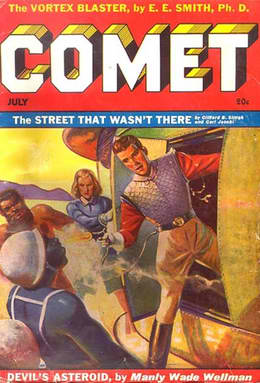
The Street that wasn't There, Clifford Donald Simak and Carl Richard Jacobi

I'm not very familiar with Clifford Donald Simak (1908-1988) or Carl Richard Jacobi (1908-1997). A little research on Simak reveals a prolific and successful writer. Jacobi was a writer of short fiction for Weird Fiction among other pulp magazines. "The Street That Wasn't There" is a short story available at Gutenberg.org.

Jonathon Chambers is a recluse. He wrote a book long ago that disgraced him and basically ruined his career as a professor. His theory was that perception created reality and the world.

There have been many wars and plagues decimating the population of earth. There are few people left to perceive reality. As a result, reality is slipping away. "There were not sufficient minds in existence to retain the material world in its mundane form. Some other power from another dimension was fighting to supersede man's control and take his universe into its own plane!"

In some ways, this is an extension of religion that suggests that the universe was created for the benefit of men by a deity for whatever reason. If men are therefore mostly wiped away, what is there left to perceive, and if there is no perception, how does it continue to really exist? This is a very good question--one that I have asked myself, but on a more personal level. That is to say, if I cease to exist, then so too does the universe from my perception. It's my perception of reality that gives reality an existence. We cohabitate with one another. I'm sure anyone can say the same thing: once they are dead or cease to perceive, what exists at all? If a tree falls in the forest, but no one can hear it, does it make a sound? Take it another step forward: if a tree falls in the forest, but I cannot hear it, does it make a sound? The obvious answer is, yes, of course.

Simak-Jacobi mention another city of futuristic and fantastic proportion trying to supplant the old. But it is never truly explained: are people disappearing and populating the new city, or are they simply ceasing to exist and a new people taking over? Is it alien? Is it some deity replacing a species too violent to exist?

This short story, like most superior literature, begs great metaphysical questions, it does not give answers.

Sunday, July 17, 2016

The Gifts of Asti, Andre Norton

This is the third story of Andre Norton's that I have read. Andre Norton (1912-2005) is a legendary writer from the Golden Age of sci-fi. "The Gifts of Asti" is available at manybooks.com, feedbooks.com, gutenberg.org, and many more locations.

The story is a fairly simple one. It's either set in the very distant future or the very distant past. One culture is being destroyed by a barbarian one. As the last of the 'virgin Maidens of Asti' of that culture flees with the aid of a reptilian servant, she discovers a well preserved man. The lake in which she finds him preserves everything for as long as they are in the lake. They do not age or die.

They discover a mostly destroyed ship in the lake, with the parts sticking out of the lake rusted to dust, while that sticking in the lake is still in good shape and without signs of damage aside from what happened with the crash. The lake is described as alive, so they do not drink of it (and why not if it preserves life?)

They rescue the man who is a hardened warrior, not like her dying people who had had everything done for them and gone soft. That seems to be a frequent motif with both "The People of the Crater" and "The Gifts of Asti." I suspect that this is a motif born from the competing ideologies of communism and capitalism, or, perhaps a consequence of a long lasting peace. Just like "The People of the Crater," the woman is a religious figure while the man is a human warrior come to give an almost extinct species hope. However, of course, biologically speaking it would be nearly impossible to accomplish this with just two people. But, that is the story from Genesis, isn't it?

Saturday, July 16, 2016

All Cats are Gray, Andre Norton

This is the second piece of Andre Norton (1912-2005) fiction I have read. Andre Norton is a famed and richly decorated author of science fiction and fantasy. It can be found for free at Gutenberg.org. The story's author is listed as Andrew North.

I'm not sure if the note is Norton's or the editor's. However, it seems to attempt to bring some kind of advantage to someone who is disabled. The disability is fairly minor: Steena, the protagonist of this story, is color blind.

I think she's the captain of a salvaging vessel looking to loot The Empress of Mars, a famous ship for having a glorious loot that no one seems to be able to win. Norton calls it "a Flying Dutchman of space." It's haunted by a ghost, or perhaps more accurately, an invisible alien. Because she and the cat called Bat are colorblind, they are able to see the invisible alien who lives only to kill those seeking to plunder The Empress of Mars. Why exactly an alien would want to be stuck all by itself on a ship like that is beyond me. However, Steena is able to barely see the creature, and Bat can see it easily enough. She guns it down and the crew become rich for it.

I wasn't too impressed with this story, either. I have several more of hers to go through in the next few days.

Sunday, July 10, 2016

The King of the City, Keith Laumer

I have a recollection of being a fan of Keith Laumer when I was in my teens. Like most books and/or authors that I read from this period of time, what I recollect in terms of the skill of the author or the quality of the story, has mostly changed. Further, my memory of any details of said books is mostly lost (with some notable exceptions). In Laumer's case, I can only, and very dimly, recall Retief as a character from a few of his books. "The King of the City," by Keith Laumer, is available freely at Gutenberg.org.

This story is rooted in action. Most of it involves taking a man into the big city in a car. Except, this is in the future, several centuries from now, when major governments have broken down. All that is left is fractious city states in the hands of cut throats.

The car itself that he uses to drive is fast, going in excess of 150mph (240km/h). It has weapons. It has no intelligence at all (something to be expected in the near future), and so the driver drives and shoots at the same time with his passenger in the rear.

There are several checkpoints in which he has to mix fighting and bribery to get through.

But, overall, the story is rather dull. I don't recommend it. There are several others of Laumer's on Gutenberg. I will read a few more. On the bright side, there's no sense of sexism or racism here. Everyone is male. Everyone, I assume, is white.

New Lamps, Robert Moore Williams

New Lamps is a short science fiction story previously published in Other Worlds. I am unfamiliar with Robert Moore Williams and have not read any of his work before. It's available for free on Gutenberg.org. It's not really a great read. However, it sure points out the lousy way Williams saw women.

One of the first things that I first noticed were the breasts of his female characters. 
She was tall, lithe, and full breasted... He had spent most of his life in the laboratories of Earth... the women who had been there (in the labs on Earth) had been flat breasted, pale creatures in low-heeled shoes...
The main character, Ronson, has gone to Mars to meet someone who has managed to cure Martians of incurable cancer.

He meets two other earthlings, Jennie and her helper, Sam Crick. Jennie is the 'full breasted' one already described above. Cancer was going to kill Ronson, and he hoped this Les Ro would be able to help.

Two murderers and a leper, who had gone on to get treated with them are all cured. The two murderers are cured of their desire to kill, and the leper is healed of the disease.

Jennie is tired of being a weak woman ('her' words, not mine):
"...there's always been a fight within me. Instead of being a woman, I have only succeeded in being a bitch, all jangle of nerves, always trying to do what the men did, but knowing I really couldn't because I was a woman."
I guess Les Ro is able to cure Jennie of not quite being a woman:
She was becoming something else--a woman. The fact showed in the gentleness of her smile.
It reminds me of the complaint that I hear from time-to-time, about women being told that they need to smile.

I can't imagine how it must have felt in those days long ago. Girls seem to be treated so badly in fiction. They rarely have important roles, and their femininity is weak and powerless. When they are strong, they're 'bitches.' She couldn't be as strong as a man because she's a woman. But she's too strong to be a woman. The Martian doctor cures her of her strength and character in order for her to become the weak woman she wanted to be. Instead of the strong writer traveling around the solar system, writing stories, being famous, isn't as important as being a man's sidekick and object of physical attraction.

Monday, June 6, 2016

Prospector's Special, Robert Sheckley

Mostly I've been pretty happy with the tales spun by Robert Sheckley. This one is not a favorite, but there are a few interesting bits. "Prospector's Special" is available online for free at Gutenberg.org.

This is a story set on Venus. I guess at the time there was fairly little practical knowledge about the planet. It is closer to the sun, so therefore must be hotter. So it must be a big desert? That's essentially what this planet has.

The main character, Morrison, is on a high risk venture looking for something called goldenstone. He's spent his las
t dollars (and there's no credit; credit is illegal on Venus) on outfitting the trip. Unfortunately for him, despite some ultra advanced technologies, his vehicle cracks up and leaves him stranded.

He is able to order water from a company that is able to materialize water to pour into his container, for a price. When they find out that he's out of credit, they cut him off. Postal service comes from a robot that appears and disappears in a little tornado. At last, he is able to find a rich vein, but his phone is out of credit and they refuse to loan him anything. The postal robot, however, comes back. He asks to borrow the emergency phone, but the robot refuses, citing laws. He beats the robot up and threatens to kill it until the robot finally agrees to let him use the phone (what else would this emergency phone be for? Just for the robot? It wouldn't be built into the machine?) In any case, he's able to send a sample of the goldenstone to a company that is able to verify its value. They are able to rescue him and I guess he lives happily ever after. The story ends here.

The other bit that is interesting is that he is trying to save money for a farm under the sea. Was Sheckley thinking that earth would run out of land as the seas rise? I am not sure, but I wonder if global warming and global sea level rise was a concern when this story was published (1959).

Wednesday, March 28, 2012

Asimov's Science Fiction Magazine - April 2012

http://ebooks-imgs.connect.com/product/400/000/000/000/000/628/297/400000000000000628297_s4.pngWell, late last week I read the March 2012 edition. I was a little disappointed by its size: a paltry 50k words. They have, however, made up for it this month with about 100k words consisting of two novellas, one novelette, and six short stories. I didn't think much of some of the choices that went into Asimov's last month, either. It's supposed to be a science fiction magazine. I guess they push out some fantasy, too. But two of the stories from last month couldn't have been categorized in either genre. I hope that the editor has a better grasp of genre for this edition.

The Last Judgment, James Patrick Kelly

The setting of this story is perhaps the first thing to catch the attention: all the men are dead. They've been eliminated by an alien species of bird which found the men to be simply too violent. Eliminating men essentially stopped all the wars and murders, as was hoped. But, naturally, such a change in demographics, not to mention population, caused a serious disruption to the remaining inhabitants.

Subsequently, all romantic relationships are now lesbian. Robots have taken over the roles which men usually dominated and which women have been quite content to leave to the men. For example, garbage collection, construction, etc. Also, the tasks usually allotted to women that women did not appreciate, have been picked up by the robots: cleaning the house, dishes, though cooking still seems to be a human task. Thus, the surviving trades are picked up by the surviving women. Despite the help of the bots, the economy is weak. The protagonist uses a bicycle to get from point-A to point-B. Certain vegetables, like asparagus, are so expensive that even for a family of a doctor and a private investigator, it's a rare treat.

The protagonist sounds like a butch dyke. Well, I say that but really she sounds like a man. Maybe that's because it was written by a man. Rather than try to disguise that fact, he goes the other way by inserting a macho voice into the inner and outer dialogue of Fay Hardaway.

What gets things started is that a painting has gone missing. One of the most politically powerful grannies has had a Bosch go missing. She believes her granddaughter has stolen it, and she's tasked Hardaway with finding it and her daughter. Before she finds the painting, she finds a dead body. Then it's revealed that the painting may have been stolen to raise the money needed to change the gender of one woman into a man. This belief is uncovered as untrue. The Bosch may have been stolen by one of the robots. Apparently the picture of the devil was painted over another picture of a devil (does that make sense?) which looks like the devils that fly about the earth and caused the near extinction of the male.

The devils, it's suggested, may regret having caused the extinction of the males. Perhaps it's caused more harm than they'd expected or wanted. However, nothing is ever conclusively uncovered.

The voice of this story was fun, even if it was more macho man rather than macho dyke. I can't help but wonder how extreme feminists would have reinvented the characters in Kelly's novella. I would think it would have been more utopia than dystopia. An end to the wars? It's only been forty years that the women have had a chance at getting used to the change in the world. There's an optimistic uptick towards the end as well that, once all the memories of the missing men had died with all the grannies that the new generations wouldn't be depressed over something that they didn't feel was missing.

Living in the Eighties, David Ira Cleary

This is another time travel story. I've never been a big fan of them. They never quite seem to work all that well. Well, this one has a funny quirk whereby the effect of time travel is achieved through a website and music.

I seem to remember reading a story like this: Boy meets girl. Boy loves girl. Girl dies. Boy finds time machine. Boy uses time machine to rescue girl from her untimely death. The twist to this is that the older man this boy becomes to use the time machine as a vehicle to rescue her causes her death before the relationship has the chance to mature to the point where he will do anything and everything he can to save her. In effect, the significance of her life fades away from him as the memories he had of her disappear from the elderly version of him never had the youth spent with her.

I guess I find this to be a bit of an overused plot line. And, as I said before, I'm not the biggest fan of time travel stories.

Something Real, Rick Wilber
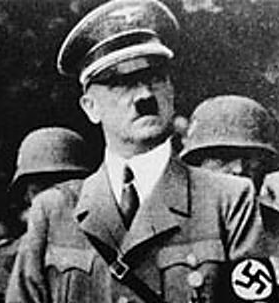
Adolf Hitler in Yugoslavia.Adolf Hitler in Yugoslavia. (Photo credit: Wikipedia)Another time-travel story, but this time told from the perspective of a man who is used by a woman to achieve a preferable outcome in history. In this we are revisited with the epic struggle between Nazi Germany, America and England. The number one issue here is the big bomb. This is the one which the US used on Japan. But in this timeline, Einstein has been killed. He is not able to assist the Americans get to it first, and instead, the Germans are going to get there first. That is if the protagonist, Moe Berg, cannot find a way to kill the lead Nazi scientist on the project.

A girl travels back in time several times in order to alter history to make sure that he kills the scientist in several different realities. He's the only man who can do it consistently throughout all of the variables.

There are some funny inconsistencies with history throughout this piece that I believe are standard run-of-the-mill revisionist American pseudo history that is common amongst the political right wing and righter wing which make up the Democrats and Republicans respectively. For instance, the stance that the US and England declared war against Germany on the same day is not correct. It took Japan's invitation to the war for the US to get involved. England went to war in 1939 while the US involved itself in 1941. It's pseudo history where American involvement signifies the start of the war.

It's also pseudo history to write that it required the atom bomb by the US to stop the war in Europe. Germany had fallen on its knees in supplication to the superior forces of the allied nations while Japan was desperately trying to keep the US off of the Japanese homeland that the atomic bomb was deployed. It had nothing to do with Germany's surrender.

I suppose the fact that the story follows in third person limited along with the baseball player/super intellect who doesn't travel the time line on his on volition somewhat makes this story unique. But not enough to make up for the author's lack of historical or political knowledge. In this case, it was a simple case of American narcissistic literary trash.

Bonding with Morry, Tom Purdom

These next two stories involved robotic nurses. This first one revolves around the character of Morry. He's an elderly man who had made it through the 70s with computer card programs and the like as a programmer. He's at the end of his life, and he's got a robotic assistant who is helping him.

It is many things to him: a nurse, a companion, and to an extent, a friend. Even though he calls him a toaster on several occasions, it is clear that he prefers his company to that of the human variety. However, as time progresses, the superficial aspects of the robot end up offending people. They want the robot to have a pleasing appearance and arms, and even a name, rather than the mechanical name of clank, like that of the sound of metal striking metal. It is deemed dehumanizing and inhumane for the robot. Gaining anthropomorphic attributes, humans wanted and demanded that these robots be given human rights. This is despite the fact that the robot does not care or even understand.

Morry, himself, is more concerned with what is under the surface. He often says that no matter what one does to change the appearance of the robot, inside it's still the same thing. Towards the end of Morry's life, where Purdom writes, "He (Morry) didn't have to raise his voice. Clark could adjust his hearing. Clark had routines that could enhance garbled words." It reminded me of Terminator II where the cyborg is being praised for its excellent attributes as a father:

The terminator, would never stop. It would never leave him, and it would never hurt him, never shout at him, or get drunk and hit him, or say it was too busy to spend time with him. It would always be there.  
Essentially, that's what Clank (later renamed to Clark after being pressured by pro-roborights lawyers looking for a fight) is to Morry. He does everything, 24h a day, to make the best of Morry's remaining days in a way that no human nurse could.

But, does Clank/Clark have feelings? That's a little up in the air. When Morry is about to die, he says to Clark:
"Tell the programmers... and the... engineers... they did a great job. All of them. Everywhere. All my life."
Clearly Morry knows that his life was enhanced by the companionship and help of the tireless nurse. But Clark's reaction is a little open for interpretation:
Clark's face froze. Morry stared at him through a haze that seemed to be darkening by the second. The smile that ended the freeze was a thin Clark smile, but he could still see it through the fog.
Now, why is his face frozen? It's the first time his face freezes, and the smile itself is 'thin,' suggesting a forced smile that is not genuine. Is the author suggesting an emotional reaction? And then finally:
"They said to tell you thank you. They appreciate the thought."
Was his face frozen because he was contacting the programmers, or was he reacting in a way that would not cause any stress to his client/friend/master(?). That is to say, a few moments would not be time enough for a human to get that kind of input and then issue a response. Or, perhaps it was more like the query of a database followed by a standard reply. But, the thin lipped smile makes me lean towards the idea that the author was hinting at the robot having human feelings. In a way, being hurt by still being thought of as nothing more than an impersonal toaster.

I enjoyed this story. It had a lot of political commentaries on the nature of humanity and politics without a clear sense from the author of what we're supposed to think. That's actually the way I prefer it, so I mean that as a compliment to the author.

Sexy Robot Mom, Sandra McDonald

This was the second robot story. I also enjoyed it. It made me think of the Surrogate Womb, which is a Korean story about a young girl who is impregnated by a noble whose wife cannot bear a child. When she has to give up the child to the nobles, it depresses her and she kills herself. The sexy robot mom is a surrogate mother. Donors give their egg and sperm to the robot, it is planted in its womb, and the result is a baby. The robot, unlike the movie version, has no feelings about losing the baby. But she is programmed. Then, the unexpected happens.

Rather than global warming, there came instead a sudden global cooling. I can't picture things happening in quite the way they were written: snow permanently on the ground, like a new Ice Age. However, during an Ice Age where snow permanently hits the ground, ice builds up: snow compacts, new layers are added, and it grows. Glaciers also grow and eat up countryside. That aside...

Despite fifty years of housing the same fetus, it's still alive and can be borne. This we find out after she/it is dug out by a gender conflicted person (top half female, bottom half male) who happens to be her grandchild. The robot disagrees and says that she merely housed her. Despite being told that the clients whom she served were likely dead and gone, she cannot alter her course. She has an override code, but no one knows that code since all those people are dead.

She's also like a terminator: programmed to fight, doesn't have a problem with 'cannibalism' in order to maintain nutritional requirements to enable the child to grow within its 'womb.' However, we are only shown its thoughts, not the action of it.

I thought this was an interesting twist on the robot as a parent/caregiver. It had the same coldness as the previous story by Tom Purdom, but without the lingering, unanswerable question at the end. It's clear she has no feelings, only confusions caused by circumstances for which she was not programmed and adherence to the mandate set before her, despite the fact that she cannot meet them.

Sensitive, Compartmented, Gray Rinehart

In this story, the psychic abilities to read people's thoughts and feelings can be implanted by a doctor. I think the premise is somewhat funny. How would a machine be able to give someone the ability to read people's feelings, but not be able to feed the same data to a computer to be read by a dispassionate audience. What's more, the doc forgot to include an on-off switch. That means that she's got to be placed inside of cages which absorb the high numbers of personnel who would otherwise overwhelm her mind. Well, a part of enjoying a story is to accept the illogical to an extent. I don't know if these problems I've listed caused me to not enjoy this story, or if I brought them up because I didn't enjoy this story.

In any case, this is the story of a girl, Holly, who has the implant who is sent on a special spy mission. Her plane has a problem, and she has to eject. The Soviets manage to pick her up before the Americans can. On board their ship, she meets a man who has had the implants since he was a boy, and is better able to focus his abilities. He goes so far as to 'rape' her by forcing his mind into hers and basically undressing her, or stripping away the facade that is our external or 'public' selves.

She manages to break free from her prison, and at the height of the action, kills the man who had raped her. The crew onboard the ship did little to stop her. Perhaps they had grown weary or fearful of their medically enabled psychic and wanted him dead as much as she did. Having killed him, they gladly hand her over to her own government.

As I said before, this story is kind of funky on a logical level that I wasn't able to endure well.

Souvenirs, Ian Creasey

On another planet, far far away, in a period of time, far far from now, a lowly trinket seller sells an item to a passerby. The passerby gives her a counterfeit bill--a big one. As a result, she hunts down the criminal (it's a small port with a very small number of transients passing through), so there's not too much she needs to do to track down the criminals. The port authorities fine the merchants whose sailors had broken the law and she gets a cut.

There's not too much to the plot. I think it suffers from being a little too short. I enjoyed the setting he created, as well as the character, but I think he stopped too soon and the result came too easily. I liked the idea of synthetically manufactured meat (like artificial flavouring, the cell from an animal is multiplied until it forms a steak for consumption).

Greener, Josh Roseman

This is one of those stories that makes me shake my head. There's very little sci-fi here. It's just about a man who marries a woman on contract. When that contract expires, he doesn't renew and wants to enjoy the single life. Finding that life not nearly as great as he'd remembered, he goes crawling back to his love interest. The only thing that was science fiction was the fact that they had a gadget that could scan a person to see if they were infected with a virus or disease. That would be a nifty item. The other thing was the moving sidewalks elevated above the ground. But, these are not the main compelling parts of the story. It's just this kind of lame drama.

Riding Red Ted and Breathing Fire, Carol Emshwiller

This lady, the author I mean, is 90 years old with a respectable career behind her. She's still churning out stories. That's got to be worth something right there--worth a lot of respect to say the least. I hope I'm so energetic when I hit her age, not to mention with a few awards in my ancient history (and recent, too).

Well, this is the story of a man who is going to a village to collect a volunteer. He calls it the tithe. He rides a dragon to bring back with him a woman whom, I believe, is set to be a sacrifice. The sacrifices don't need to come often. He mentions that once his dragon has eaten, it is fine for nutrition for a few months. This might work for the crocodile who mostly sleeps with his little brain and electrical system always on the alert for an opportunity, gets his energy from the sun to warm his body, etc., but it's not logical for an animal that flies. Animals that fly can consume their own weight in food daily just to have enough energy to fly. They also have small brains which require few calories.

OK, that gripe aside, the warrior who enters the village is met by the sacrifice. But, she is too old for him. He expects a young and beautiful sacrifice. He decides to raid the village to find a more suitable candidate. While doing so, he thinks he's allowing himself to be overpowered and captured. However, I'm a little skeptical. There is this idea that maybe he, a mighty and manly macho warrior, just isn't comfortable with the idea that he is overcome by and mastered by women.

The women like him, though. And though they had set him up to be a sacrifice himself, his dragon actually cares for him as he cares for her. As a result, she does not eat him (of course, maybe she's just not that hungry, as he mentions earlier). They also decide to adopt him as one of their own, and he keeps subsequent tithes from being extracted or even attempted.

This was a fantasy tale, which is something I don't really like about Asimov's magazine. I expect it to be a sci-fi magazine, not a blend of the two. There is an article later on that debates that sci-fi and fantasy are mostly married to each other, but I don't agree with his analysis. I'll get into that later when I talk about his or her essay.

On Books, Norman Spinrad

Normally I don't comment on what appears in 'On Books." However, in this case, I feel that I want to caramelize my thoughts concerning the mixture of fantasy into science fiction. I do that by writing this reading journal. Following a listing of some rather expensive books, he gets into an essay on fantasy and science fiction.

He writes about an old argument over "whether or not 'science fiction' and 'fantasy' were really aspects of the same thing, or whether lumping them together as 'SF' was actually a shotgun marriage for the marketing convenience of the publishers holding the said marketing weapons." I think straight off I can say that it is not unusual for readers who enjoy science fiction might also enjoy fantasy, or vice versa. Both genres require the ability to imagine what does not really exist: not yet, or maybe never. But, in the case of science fiction, it can often be a matter of 'not yet' vs fantasy 'not ever.' Also, it might be said that the author of some fantastical fantasy story might also have an imagination for a fantastical science fiction. However, I think that this is short sighted.

The canon of vocabulary for science fiction comes from a distinctly different canon of literature than fantasy. Fantasy has an old and direct lineage: it is a child of the myth, the legend, the religion (in the mythical sense), and the fairy tale (I'm sure I'm missing a canon somewhere, but my drift ought to make sense). Where does science fiction come from? Well, I would say it comes from the advance and speculation of science, which in itself has some aspects of religion but distinguishes itself by aiding in the technological advancement of first world, second world, and hopefully, one day, third world nations.

One notion that Spinrad brings up is the idea that the idea of faster-than-light travel is impossible, and therefore if a story incorporates that type of idea into the story, then that is an aspect of fantasy because it's not science. Well, that's what I call the science of myth, or the mythical or religious side of science. Because we cannot see what moves faster than light, it does not exist. It's as if what we cannot see is a clue as to it not existing at all. But, speaking in terms of relativity, we already know that a wavelength changes in intensity with the relative speed of a given object. If an object is travelling at the speed of light relative to you, then the light will only reach you as it passes you, and only for an infinitesimal period of time (like that of the length of a single photon), and as it moves away at that same speed, the wave would be so weakened as to make it entirely invisible. This is all assuming that the travelling object is all that visible. A black rocket would not reflect light at all in any event. The whole notion that we know enough about the universe to discount the possibility of it existing, to me, is a fool's superstition, and a popular one held by many modern physicists.

With that said,
Spinrad interprets the definition of science fiction as literature that speculates within the bounds of the known laws of mass and energy, the reality in which the readers find themselves, and fantasy is the literature that lives outside the boundaries of the scientifically possible...
But, consider that science is only an interpretation of the known universe, and that the actual properties of the universe, we're relatively ignorant of. Consider that Lord Kelvin said, "Heavier than air flying machines are impossible." So, being one of the greatest minds of his time, this was science. How foolish that idea seems to us now! Many ideas were postulated by scientists that have later been proved incorrect. So, for an author to assume that one day science will find a way to make the impossible possible does not mean he is speculating about fantasy rather than science fiction. The 'known laws of mass and energy' are moving goal posts. That's not about to change any time soon. 

I'm not about to write that fantasy and science fiction cannot mix. Of course they may. But my point is that fiction, science fiction, which challenges or ignores the scientific myths or laws of today may be speculative and hard science fiction rather than what the author purports. In my estimation, pointing again at faster-than-light theory, believing this idea might make us feel safer from invasions and put ourselves on the pedestal that only narrow minds and ignorance allows us to.


Méliès, viaggio nella luna (1902) 12
Méliès, viaggio nella luna (1902) 12 (Photo credit: Wikipedia)
So, I seek to define hard science here with a more realistic phrase: hard science fiction is science fiction without balls. It believes in the fiction that we believe in in our day. It's fiction within the mythology that the temple of science preaches to us at this period of time. Therefore, anything such as Verne's 20,000 Leagues Under the Sea would be considered fantasy fiction since the science of his day would have surely deemed such a machine impossible. Voyage Dans La Lune, ignoring the fantastical ideas about people living on that planet and the other fantastic and surrealist ideas which were made with the film. One might say that some of the ideas might have come from mythology surrounding the moon. However, since flight itself was deemed impossible by the doctrines of science in 1902, would that mean that by this violation alone that it would be soft science even though we now know that flight to the moon is in fact possible?

One funny thing that the author of this article came out with is the idea that China Miéville is a 'much better and more subtle literary artist than Lovecraft.' That, of course, is an idiotic statement. Also, what point is there that he's trying to make about the definition or mapping of the genre of science fiction and its sub-genres? How about saving such smelly opinions for an essay comparing a legendary author to a moderately successful modern author? I find unlikely that China would have made such a moronic observation. Quite frankly, where the previous arguments he made were arguable, his opinion on this matter seriously undermines his credibility. 

In any case, I was less interested in his analysis of the books he reviewed than in the outline and definition of science fiction.  

Conclusion

I cannot complain about the value of this particular volume of the magazine. It was a short novel. Most of the stories were real science fiction. Some were fantasy. I do wish they'd stick to sci-fi and leave fantasy to fantasy magazines.

You know, what would be more interesting than these ads for the books that they're pushing is an analysis of the stories which are printed in Asimov's Science Fiction. That way, the reviewer can put in his or her thoughts in the fiction and the meaning of the fiction in the stories we have at hand. 

Enhanced by Zemanta