Showing posts with label mystery. Show all posts
Friday, February 1, 2019
A Case of Two Cities, Qiu Xiaolong
This is the fourth book from Qiu Xiaolong involving his star character, Chief Inspector Chen Cao. I have greatly enjoyed the series. There are a few things that bothered me about this volume. In perhaps the first 1/3-1/2 of the novel, I was bothered by bad grammar and bad grammar choices. By bad grammar, I mean run on sentences and sentence fragments. Bad grammar choices involved far too many commas creating a jerky narrative. Together, these two issues almost made me hit the delete on my Kindle. One of the style choices I didn't like in the first three books was the inclusion of poetry lines jammed together like prose, separated by the forward slash /. I suppose he might have saved a few pages and a few trees by doing so. But in an electronic copy, what's the point? In any case, that was improved upon perhaps 50%+ of the time. That is to say, in volume four, maybe greater than 50% of the time the lines of poetry were on their own lines as poetry ought to be displayed.
The story itself is otherwise fairly well told. But, while not really an issue I guess, I didn't get a very good look into China. Most of the story takes place in the US. There was the issue of corrupt people stealing Chinese public funds or taking advantage of Chinese laws meant to stimulate the economy to give themselves leverage they needed to create vast sums of personal wealth, in order to build luxurious lives for themselves in the US before their corruption caught up with them.
Chen is given 'the emperor's sword' to deal with going after Xiao. But he doesn't get far, and there is a great deal of risk to him. One detective who may have been assigned to the same file was killed. The first person he questions has information about Chen before Chen has had a chance to question him. The target becomes too dangerous for him, so the next person he goes after for questioning he gets the leverage of some pornographic photos with another official, Jiang. She ends up dead in short order. Then, Chen is sent to the US to get him out of the way or to make it possible to get a roundabout inroad towards the defecting Xiao. But he goes not for the investigation, but as a special envoy. Perhaps a kind of undercover operation where everyone knows who he is, but not exactly why he is there. This includes himself. Someone tries to kill him, but gets someone else instead.
In the end, he attempts to thwart Jiang's escape to Canada, but the outcome is left out. The end of the narrative has many loose strings. I don't object to that entirely. But I suspect many readers might. Loose strings are easier to pick up later than a narrative which is carefully and surgically sutured to have no loose ends.
I'm sure I'll get into book 5. My theory is that this book had a different editor than the first four. I tried to find out by looking up the book on Amazon and Goodreads. But getting that information isn't so easy. I'm sure if I spent more time I could eventually figure it out. But how important is it? I'll just leave my guess here.
Goodreads first three or four reviews had similar experiences to my own: enjoyed the first three novels. This novel is of inferior quality.
Cheyanne wrote, "But this case has two many murders, with victims and killers we barely get to know. We also get barely a glimpse of several recurring characters."Shabbeer Hassan wrote, "A rather disappointing book in the Inspector Chen series, with a weak story (as usual) but much weaker character motivations and horrid pastiche of Inspector Morse by Colin Dexter.
I don't know who Inspector Morse or Colin Dexter are.
Orinoco Womble (tidy bag and all) wrote, "Golly I hate to say this, but I was disappointed. Four novels into the Chen Cao chronicles, I guess it's normal that the author should lose a bit of headway. The case looked promising: an older, respected cop is found dead in a fancy brothel, and Internal Security gets a "confession" from the terrified young prostitute far too quickly. What's up? Well, you won't find out here."
There were some positive reviews. Follow the links and I'm sure you'll find them at Goodreads.
Thursday, January 10, 2019
Murder on the Links, Agatha Christie
Murder on the Links was published at around 1923. At the time, Agatha Christie was an up-and-comer. Wikipedia writes that a review of the time compared Agatha Christie's Poirot to Doyle's Sherlock Holmes.
Poirot is asked by Paul Renauld to save him from some kind of plot. But ultimately, it is too late. When he arrives, Renauld is already the victim of a murder. Renauld is a rich man. Surely if he was worried about being murdered, why wouldn't he hire some security? I guess then we wouldn't have a murder mystery novel then, would we?
Christie creates another detective to act as a kind of foil to Poirot. He is comically illustrated as being arrogant. Sometimes, at the scene of a crime, he is on his hands and knees looking for evidence. While doing so, he discovers an unburnt match and a cigarette butt. They are of South American origin. All of this plays along the idea of some foreign interests being behind Renauld's murder. Meanwhile, he ignores a pipe which Poirot finds to be noteworthy. Poirot mentions that any evidence, big or small, is important. They jostle with each other, but in reality, Detective Geraud is quite dedicated to doing his detective work. Later on, he is discovered disguised as a bush so that he can overhear conversations.
Ultimately, he identifies Jack Renauld, Paul's son, as the murderer. Certainly, it seems likely. Jack even confesses to the crime. But while all of this is enough for Geraud, it is not enough for Poirot who sees that the confession is false. Jack wants to cover up for the person whom he loves and believes to be responsible for the death.
Ultimately, it is his other love interest who murders his father in a case of mistaken identity. The intended target was Jack, who was losing interest in the beautiful French girl, Marthe.
I enjoyed this book.
Poirot is asked by Paul Renauld to save him from some kind of plot. But ultimately, it is too late. When he arrives, Renauld is already the victim of a murder. Renauld is a rich man. Surely if he was worried about being murdered, why wouldn't he hire some security? I guess then we wouldn't have a murder mystery novel then, would we?
Christie creates another detective to act as a kind of foil to Poirot. He is comically illustrated as being arrogant. Sometimes, at the scene of a crime, he is on his hands and knees looking for evidence. While doing so, he discovers an unburnt match and a cigarette butt. They are of South American origin. All of this plays along the idea of some foreign interests being behind Renauld's murder. Meanwhile, he ignores a pipe which Poirot finds to be noteworthy. Poirot mentions that any evidence, big or small, is important. They jostle with each other, but in reality, Detective Geraud is quite dedicated to doing his detective work. Later on, he is discovered disguised as a bush so that he can overhear conversations.
Ultimately, he identifies Jack Renauld, Paul's son, as the murderer. Certainly, it seems likely. Jack even confesses to the crime. But while all of this is enough for Geraud, it is not enough for Poirot who sees that the confession is false. Jack wants to cover up for the person whom he loves and believes to be responsible for the death.
Ultimately, it is his other love interest who murders his father in a case of mistaken identity. The intended target was Jack, who was losing interest in the beautiful French girl, Marthe.
I enjoyed this book.
When Red is Black, Qiu Xiaolong
This is the third novel in a series about Chief Police Inspector Chen. Chen is on holiday for most of this book, and only marginally involved with it as he's on a holiday. He leaves the case mostly to his sidekick, Sergeant Yu.
The takeaway for me from this book is the fact that Mao had a way of betraying his most ardent followers. The Red Guard which is created by him becomes politically incorrect. So, all those people that the Red Guard identified as being anti-Mao, or something to that effect, themselves become persecuted.
Another issue that becomes apparent is that an honest policeman in the 90s quickly got left behind the economic boom which came after the government, under the leadership of Deng Xiaoping, decided to open up the country to capitalism. He was a victim of that Reagonomics trickle down theory whereby if people are allowed to become very rich, the money that they make will trickle down to the poor and everyone gets richer. I think that's BS now. Clearly that's not what's happening today. But, millions of people were able to live themselves above poverty. But I think that this is the result of opportunity rather than trickle down effects.
What I really like about Qiu Xiaolong's books is reading a lot of the backstories that build up the present who-dun-nit. The meeting of the murdered woman and a poet in a reeducation facility makes these politically black people into greater astigmatism. For refusing to end the relationship, half of her head is shaved, and she has to wear an old shoe around her neck. While he is forced to wear a tiny chalkboard around his neck.
Publisher's Weekly writes, "Only a banal solution to the mystery spoils an otherwise engrossing read." I agree that the ending is a bit banal. But I don't think that's a problem. The ending is a bit simplistic and a bit of an oddball, nothing fancy. But I don't think that that's really a problem with my reading of the novel. The more important story is how major historical events which become little more than notes on timelines create an endless tapestry of events which lead to an unfortunate end for an unfortunate victim.
I enjoyed the book and look forward to reading the next in the series.
Thursday, September 1, 2016
The Moonstone, Wilkie Collins
The Moonstone (1868) is another classic detective story of fame that I have chosen to read. It's written by the acclaimed Wilkie Collins (1824-1889). According to Wikipedia, among other sources, this is the first English detective novel. The Moonstone is a diamond which was looted from a holy Indian site by the English, which eventually falls into the hands of Colonel Herncastle. It's a flawed diamond of significant size and quality. There are several Indians who are looking to retrieve it for their temple. The Colonel Herncastle is ostracized by his family. The diamond is considered to bring with it a kind of curse. Therefore, as the Colonel is dying, he bequeaths it to she, Rachel Verinder, whom he considers the original instigator of the ostracism on the date of her first birthday after his death.
The story is divided into several parts. Part one follows the narrative of an elderly servant, Gabriel Betteredge, who has served Lady Verinder's family for pretty much his entire life. He's an honest man with a few interesting traits that stand out. First, he loves Robinson Crusoe, a book which is his favorite literary retreat which he mentions several times throughout the narrative. Initially he served as a grounds keeper. But in his older age, he is turned into a well respected servant. It's hard to imagine working into your 70s with never a retirement in sight.
After the first detective investigates the puzzle but cannot solve the case. He therefore sends for a Detective Cuff, who is renowned for his reputation. He seems to have been able to solve the mystery of the case, but the resolution is never come to. The theory is that it was never stolen, but rather that Rachel stole her own jewel to sell it for some unknown reason.
Roseanne kills herself over Mr. Franklin. She had fallen in love with him, apparently, and he ignored her. It's unknown why she might have felt that she had some kind of possible relationship with him. She is referred to as 'ugly.' The narrator does not know, either, why she fell in love with him.
At the end of part one there are several mysteries left unsolved.
Thus far (I am at the title of part two), I am quite impressed by the book. I really love how authentically British the narrator's voice is. He has this charm and method of throwing together a phrase that has a real charm to it.
Part two is narrated by the character of Miss Jane Ann Stamper. However, she is more often referred to as Miss Clack or Drusilla. The character is a fanatical Christian. As such, she is a nuisance. Her favourite thing to do is to distribute books and pamphlets promoting her Christian cause. She does everything she can to coerce people to read it. She goes so far to say that Rachel's mother had not properly converted to Christianity, and therefore would not have achieved a position in heaven. By doing so she burns her bridges.
The mother, Julie Verinder, dies a few days after she makes her will. She had something for Miss Stamper. But rather than talk about the something she had set aside for her, Stamper insists on the subject of her views on how life should go.
There is little about the Moonstone in this part. It is more about the situation Rachel Herncastle gets into. Godfrey, her cousin, wants to marry her. He and she both change their minds. His father is most upset by this. He is the brother-in-law of Julie. Julie had named him as the person as her executor. In revenge for the breakup between her and his son, he forces her to leave the home she grew up in. The house 'was hired in his name', so I am not sure if that means it is rented or exactly what it is. In any case, her lawyer invites her to stay in his home.
It is here that the narrative of Miss Drusilla Clack, aka Miss Jane Ann Stamper, comes to an end. It wasn't nearly as charming as part one because of the voice of the narrator. Now, this is an excellent accomplishment on the part of Wilkie Collins. He manages to create two very distinct voices within the novel. I haven't yet read another novel that has done the same (although, to be sure, there must be another).
I found part two to be a bit dreary, although it was in the last scene quite good.
On to part three. Part three is narrated by Mathew Bruff, an honest lawyer who works on behalf of Rachel. The voice in this case is different again from parts one and two. Part one had a lot of sentimentality. Part two a kind of crazed well meaningness. While part three is a cold and brief accounting of his perspective on the mystery of the Moonstone. He has the theory that the Moonstone is pawned for a sum of money to be repaid in a year, or the diamond defaults to the lender. The lender is one Mr. Luker who "stand(s) at the top of the prosperous and ancient profession of usury..." If this is the case, it casts my glance on Godfrey, since he has been the one shown to require a large sum great enough that he voided his pending marriage to Rachel.
It truly is remarkable how adept Wilkie Collins is in adopting a variety of voices.
Part 4: Third Narrative Contributed by Franklin Blake. It is through this narrative that we discover that Rachel saw Franklin Blake steal the Moonstone. However, if his narrative is to be the truth (which I think is Collins' intent), then he never meant to steal it at all.
It is revealed in this part that the evidence against him held by Roseanne was in fact his sleeping clothes with the paint stain on it. She buried it in quicksand in a strong box attached to a metal chain. She leaves the information on how to find it with her trusted friend.
Franklin learns from Rachel that she witnessed him taking it, but his narrative shows that he did not know what he was doing. Nor was the diamond in his possession following the theft. So, this was the reason that Rachel hated him, but not enough to give that information to the police.
A kind of practical joke was played on Blake that night by the Doctor (Dr. Candy) who had given him a dose of opium. While under the deep drugged sleep, he had stolen the diamond. Dr. Candy suffered an illness that ruined his mind, so it is from his recorded ramblings that reveals the joke played on him. His assitant, Ezra Jennings, informs Blake of the joke when Blake tries to interview Dr. Candy for whatever information he had. Dr. Candy's illness stole the large part of his memory, and therefore he was unable to extract the confession directly.
While many of the narratives had a strong distinct voice. However, Blakes voice in this case isn't terribly dissimilar from that of the lawyer, Mr. Bruff.
The final part is told by Ezra Jennings. The voice I referred to before isn't conferred so much by the inner vocabulary of the narrator, but by his feelings and his readings of other peoples' feelings towards him.
He is a sick man, addicted to the relief of opium. His internal motivations are selfless. He is attempting to recreate the situation, with the help of some willing and some unwilling participants, the night of the Moonstone diamond's disappearance. It is sad to read how people judge him (and other people who are physically unattractive). He reacts to Miss Verinder's positive treatment of him. His sacrifices to make this experiment work is also a result of the kindness and respect that Blake had given him. (It would appear that the gratitude of the ugly for the kindness of the beautiful has a profound effect on the victim of physical circumstance):
"I can't treat you like a stranger, Mr. Jennings," she said. "Oh, if you only knew how happy your letters have made me!"
She looked at my ugly wrinkled face with a bright gratitude so new to me in my experience of my fellow-creatures, that I was at a loss how to answer her. Nothing had prepared me for her kindness and her beauty. The misery of many years has not hardened my heart...
At this point, I have concluded the tale. As expected, Godfrey was at the bottom of the theft. Blake had been an involuntary accomplice. Godfrey's crime catches up to him. When he gets the diamond back from the loan, he attempts to run away with it. He is watched, however, and murdered by one of the Indians whose mission it was to retrieve it.
They are unable to repossess it. The Indians successfully bring it back to their temple. Their reward is a punishment for betraying their caste. The diamond is seen at the temple. I think that perhaps the diamond had been stolen from their temple in the first place, and was restored to it.
The book was quite good. Although not as intriguing or well written as that of Monsieur Lecoq, the creation of Émile Gaboriau. In other ways, in particular the numerous narrative voices which were skillfully used, it is unique and masterful.
Labels:
detective fiction,
mystery,
novel,
Wilkie Collins
Tuesday, August 16, 2016
The Sign of the Four, Arthur Conan Doyle
The Sign of the Four (1890) is the second book of the famous Sherlock Holmes series by Sir Arthur Conan Doyle (It can be found for free at gutenberg.org. It is a relatively short read and easy enough to read.
The story is split into two basic parts. There's the murder, which Holmes is to solve, and the back story, which is a story of revenge. A woman asks for Holmes to help her solve the mystery of her father's disappearance. She has a letter and an invitation which leads Holmes, Watson, and herself to the scene of a freshly committed crime.
Some interesting facts about Sherlock Holmes' weakness comes to light in this case. He is addicted to cocaine, and injects himself in times of boredom. He is easily bored, and as he says, "...'there are in me the makings of a very fine loafer and also of a pretty spry sort of fellow.'"
With some clues and gross generalizations, Holmes is able to stitch together enough of the puzzle to get onto the trail of the murderer. After some frustration, they succeed in catching the criminal and getting a full confession.
There is the problem of racism in this story. The Indians from Andaman Islands are described in quite a nasty fashion:
To be fair, however, this is from a book describing these people rather than a verifiable opinion of Doyle's on the aboriginals of this island.
I have recently read some excellent books. It wasn't really painful to read, but it wasn't particularly stimulating, either.
The story is split into two basic parts. There's the murder, which Holmes is to solve, and the back story, which is a story of revenge. A woman asks for Holmes to help her solve the mystery of her father's disappearance. She has a letter and an invitation which leads Holmes, Watson, and herself to the scene of a freshly committed crime.
Some interesting facts about Sherlock Holmes' weakness comes to light in this case. He is addicted to cocaine, and injects himself in times of boredom. He is easily bored, and as he says, "...'there are in me the makings of a very fine loafer and also of a pretty spry sort of fellow.'"
With some clues and gross generalizations, Holmes is able to stitch together enough of the puzzle to get onto the trail of the murderer. After some frustration, they succeed in catching the criminal and getting a full confession.
There is the problem of racism in this story. The Indians from Andaman Islands are described in quite a nasty fashion:
'They are naturally hideous, having large, misshapen heads, small, fierce eyes, and distorted features. Their feet and hands, however, are remarkably small. So intractable and fierce are they that all the efforts of the British official have failed to win them over in any degree. They have always been a terror to shipwrecked crews, braining the survivors with their stone-headed clubs, or shooting them with their poisoned arrows. These massacres are invariably concluded by a cannibal feast.'
To be fair, however, this is from a book describing these people rather than a verifiable opinion of Doyle's on the aboriginals of this island.
I have recently read some excellent books. It wasn't really painful to read, but it wasn't particularly stimulating, either.
Labels:
detective fiction,
mystery,
Sir Arthur Conan Doyle
Friday, July 22, 2016
Monsieur Lecoq, Émile Gaboriau
Émile Gaboriau (1832-1873) was an early writer of detective fiction. My personal discovery of this character and the author comes from a passage from Sir Arthur Conan Doyle's A Study in Scarlet where Dr. Watson is asking about famous detectives. Sherlock Holmes dismisses Monsieur Lecoq as a buffoon. It's said that Doyle's Holmes overtook Lecoq in popularity and dwindled Lecoq's fame and popularity. Monsieur Lecoq is a two volume work of genius. Doyle is a good writer, to be sure, but his Holmes is not the equal of Gaboriau's Lecoq. Volumes 1 and 2 of this masterful literature can be found online at Gutenberg.org. Someone might ask themselves why I prefer Lecoq to Holmes. Holmes, without doubt, is probably capable of solving the murder mystery more quickly than Lecoq. Holmes has the ability to solve crimes instantly, almost subconsciously. Dr. Watson, with good reason, stumbles after him trying to understand the method to his madness. On the other hand, this is Lecoq's first detective mystery. He is not even a master of himself quite yet.
Lecoq distinguishes himself from the other policemen when he captures May, the suspected murderer, by going to the rear of the wine house and preventing May's escape. While his superior is quick to dismiss the murder as a simple affair between thugs, Lecoq heard May exclaim, "Ah, it's the Prussians who are coming; I'm lost!", he realized that May was not a common thug.
Gevrol, his chief, is ready to walk away from the crime with little more interest, but Lecoq contradicts Gevrol's theory. The police are described as a backstabbing lot who bother each other in a competition for the top. Gevrol is near the top and Lecoq is just beginning. Repeatedly, Lecoq examines evidence, concocts a theory, and teases it out. He uncovers a brilliant means of communication between May and the outside world as he sits in prison, but is foiled by Gevrol betraying him. Gevrol is protective of his position, and mocks Lecoq. As a consequence, he sabotages him as much as he can.
Lecoq shows great imagination and wit. He has a kind of sidekick as well, "Father Absinthe" (named after his favorite drink). And, while Dr. Watson is an intelligent man made seemingly unintelligent next to Holmes, Father Absinthe is not terribly intelligent, more interested in pursuing a drink than in anything else. Despite Father Absinthe's inferior intellect, sometimes he is able to help ground Lecoq in the more obvious observations. When Lecoq is deeply discouraged, Father Absinthe's attitude helps restore Lecoq's confidence and he rejoins his efforts.
At the end of volume 1, he has essentially given up. In a stunt to discover the identity of May, he releases him in the hopes of following him to his lair. He succeeds. However, when he does find him, he does not recognize him. He is in fact the duke, Martial de Sairmeuse and when he comes upon the duke in his own house, he is cleaned up and unrecognizable.
Lecoq is about to give up towards the end of volume one when he seeks out the advice of Père Tireauclair, (lit. Father Bringer of Light, or "Old man Brings-to-light"). Père Tireauclair is able to decipher the meaning of certain mysteries which have befuddled Lecoq on the basis of Lecoq's narrations. I find this to be a mixed bag. On the one hand, it's too easy a means to assist Lecoq penetrate the mystery. On the other, Lecoq is seen as a young man who has made mistakes. That goes to the essence of why I prefer him to Holmes. He is a young man whom I can follow, I can read his errors, and ultimately he is more of a human being while Holmes is ultimately a kind of superhero with super abilities. Where with Holmes or Agatha' Christie's Poirot, I am often left scratching my head wondering how these detectives are able to deduce the mysteries. With Lecoq, the deductions are much more lucid and comprehensible. He is a good detective, stubborn, intelligent, dedicated, honest, yet fallible, at times naive but correcting himself.
Volume 2 is mostly, save the epilogue, filling out the story, taking place 20 years earlier, behind the murder. Marie-Anne is the object of three men's desire, all of whom are ready to sacrifice everything to have her as their wife. The Martial de Sairmeuse, Chanlouineau the successful farmer who sacrifices everything to help her in her happiness, and Maurice D’Escorval who is the one who marries her.
Blanche is in love with Martial, and though once Marie-Anne's friend, she ultimately murders her in order to win over the object of her affection. The murder is attributed to Father Chupin who is himself a despicable fellow who is murdered but not for this particular crime. He takes the blame, but not before informing his eldest son about who the real murderer is.
Blanche is blackmailed by several characters and suffers a very unhappy life, despite, after having moved to Paris, being most envied at the highest social echelon. She cannot escape her guilt, though she feels justified as it happens to bring Martial back to her as her husband.
At the end, in the short epilogue, Leqoc is able to deceive Martial to a confession, but does not prosecute him. He is able to rescue his reputation and secure for himself a good future as an inspector.
The story is brilliant. In truth, the two volumes I read in two days, unable to put them down until I was finished with them. I am lucky to have discovered and followed the reference from Sir Arthur Conan Doyle's A Study in Scarlet.
Monday, June 27, 2016
A Study in Scarlet, Sir Arthur Conan Doyle
While Sir Arthur Conan Doyle isn't exactly the first to develop the mystery (all hail Edgar Allan Poe), I do believe he was the first to create a kind of serial detective. Although, interestingly, Doyle mentions two other detective near contemporaries: Edgar Allan Poe, the father of the genre, and Émile Gaboriau's Monsieur Lecoq. Certainly, he is the most famous detective: more so than even Agatha Christie's formidable Poirot. A Study in Scarlet can be found at Gutenberg.org.
Some interesting facets of Holmes is that he has no interest at all for any studies (aside from the violin) outside of those who help him to solve murder mysteries:
The second part of the novel is a novel in itself, correlated to the motivation, I suspect. At first I actually wondered if somehow this story had crept accidentally into the wrong book. After checking it out on Wikipedia, however, it is indeed a part of the story.
The story is about the founding of the Mormon Zion. A man is in the desert, his companions dead from dehydration, when the migrating Mormons, looking for a place to settle, discover them. They are then told that they can go with the Mormons as Mormons, or be left behind to die. So, of course he agrees.
There aren't enough women for the polygamous men in the cult. Thus, they go about raiding immigrants who are passing through, kidnapping the women and making them their own wives.
The narrative is quite fast paced and with almost no illumination into the minds of any character, including that of Dr. Watson, the narrator.
Wikipedia notes that Doyle regretted painting the Mormons in such a negative light, having relied on the common rumours of the day.
In any case, it was an interesting short read. I recommend reading it.
Some interesting facets of Holmes is that he has no interest at all for any studies (aside from the violin) outside of those who help him to solve murder mysteries:
"I consider that a man's brain originally is like a little empty attic, and you have to stock it with such furniture as you choose. A fool takes in all the lumber of every sort that he comes across, so that the knowledge which might be useful to him gets crowded out, or at best is jumbled up with a lot of other things so that he has a difficulty in laying his hands upon it. Now the skillful workman is very careful indeed as to what he takes into his brain-attic. He will have nothing but the tools which may help him in doing his work, but of these he has a large assortment, and all in the most perfect order."A mystery comes and is solved by Holmes easily enough. The murderer was the taxi driver.
The second part of the novel is a novel in itself, correlated to the motivation, I suspect. At first I actually wondered if somehow this story had crept accidentally into the wrong book. After checking it out on Wikipedia, however, it is indeed a part of the story.
The story is about the founding of the Mormon Zion. A man is in the desert, his companions dead from dehydration, when the migrating Mormons, looking for a place to settle, discover them. They are then told that they can go with the Mormons as Mormons, or be left behind to die. So, of course he agrees.
There aren't enough women for the polygamous men in the cult. Thus, they go about raiding immigrants who are passing through, kidnapping the women and making them their own wives.
The narrative is quite fast paced and with almost no illumination into the minds of any character, including that of Dr. Watson, the narrator.
Wikipedia notes that Doyle regretted painting the Mormons in such a negative light, having relied on the common rumours of the day.
Years after Conan Doyle's death, Levi Edgar Young, a descendant of Brigham Young and a Mormon general authority, claimed that Conan Doyle had privately apologised, saying that "He [Conan Doyle] said he had been misled by writings of the time about the Church."I cannot say of course whether these stories had any relation to truth. There are a lot of myths around the Mormons, both for and against.
In any case, it was an interesting short read. I recommend reading it.
Thursday, February 2, 2012
The Mysterious Affair at Styles, Agatha Christie
I have been watching the TV series, Agatha Christie's Poirot. I must say that I have had a splendid time of that series. It is like watching good TV, but retro to the 70s. Those were some golden years of television entertainment, and this could have stood up to the best of them. It's really an instant classic.Before the show, I suppose I had a bit of curiosity about the author and her books. Now, since the show, I am even more interested in her stories. There are several of them available for free at Gutenberg.org.
The books at Gutenberg.org are well organized. They are minimalist: could be better. But I've paid for books with much worse. In any case, go to Gutenberg.org for your free copy.
One thing that's interesting about Agatha Christie, is that she is the most singularly successful author of the last century. She has sold more of her novels than any other aside from the authors of the Bible and Shakespeare. (See Wikipedia if that seems too unbelievable). I have never read any of her books, and it's been sitting in my Kindle gathering dust. That is, until I found so much enjoyment out of the TV production.
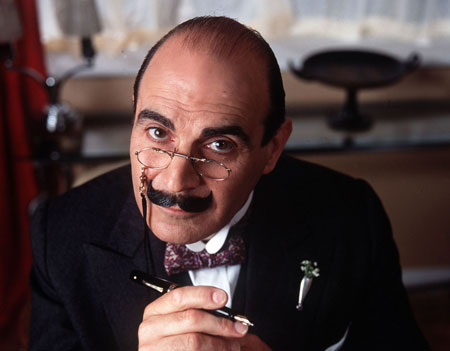
Now, into the book a bit. I'm going to contrast the writing style of Agatha Christie and Zane Grey. The reason for this is that I find Christie's descriptions of the physical properties of her scenes to be anemic. This is not just the setting, but also the characters. This was Grey's particular strength. If it were not for the fact that I had watched this episode, not to mention subsequent episodes, I would have had a poor picture of her scenes. I would not have been able to get much from Christie. The only character who gets much of a description is Poirot, the star of the mysteries, "Poirot was an extraordinary looking little man. He was hardly more than five feet, four inches, but carried himself with great dignity. His head was exactly the shape of an egg, and he always perched it a little on one side. His moustache was very stiff and military. The neatness of his attire was almost incredible. I believe a speck of dust would have caused him more pain than a bullet wound. Yet this quaint dandyfied little man who, I was sorry to see, now limped badly, had been in his time one of the most celebrated members of the Belgian police." But for the rest of them, the descriptions are very nearly nonexistent. And, as mentioned before, the setting of the house or mansion is almost nonexistent as well. Thanks to the TV series, however, I was able to fill that void. Quite easily I could imagine the Poirot who dressed much like a penguin, whose 'military moustache', which means nothing to me (what does that mean exactly, 'military moustache'?). I don't know if Agatha had the heavily waxed (or whatever substance was used to make Poirot's moustache so unique) moustache with the left and right ends made into upturned points or not. But, that's what we got from the TV movies. As such, it was relatively easy to supplement the lack of character descriptions and settings with those provided by the TV show. I must say, it worked magically. Even to the accent, there are no words to describe it. I therefore hear David Suchet's representation.The story is written from the somewhat limited intelligence (when contrasted with Poirot: however, everyone when contrasted with Poirot has a limited intelligence) of his sort-of-side-kick. He is to Poirot what Watson was to Sherlock Holmes. That is, he is a kind of foil that allows the limited intelligence of the reader to unravel the details to the mystery. His occasional dismissals of Poirot's intelligence or capability
Christie has from time to time a dry sense of humour. The bungles and interpretations which the narrator, Hastings, makes of Poirot when he seems at times to interpret Poirot as being past his prime or off his rocker add a certain levity to certain situations.
Where Christie excels is her efficient descriptions of character reactions, dialogue, and thoughts. Hastings is something of a fly on the wall. He is in fact quite intelligent. Without that intelligence, there would have been no story. For, he is the one whose eyes we borrow. It is also, ultimately, his observation of Poirot which results in the key which helps Poirot unlock the entire mystery behind the death of his and his fellow Belgian expatriates.
I enjoyed this book, but I wonder how much I would have enjoyed it without the help of the Television series.
Subscribe to:
Posts (Atom)